Kid Blink’s “Ode to the strikers”

Tags

,

HAIL TO DE STRIKE!
Der wus a row in Frankfurt-st.,
And de fight it wusn’t slow,
Between de Newsboys’ Union
An’ some fellers wat’s got do’.
It started in de mornin’
And it quitted late at night,
And wen we got troo doin’ tings,
Dem scabs dey was a site.

Fer it was strike! strike! strike! yes,
Strike ‘em on de head!
Oh, smash ‘m in der smellers,
Stick togedder, fellers,
In Frankfurt-st. near to de park.

Der wus a row in Frankfurt-st.,
De newsies dey went out;
Dey called de coppers on us
An’ we met ‘em wid a shout.
De scabbies hid behin’ ‘em,
But it didn’t do no good;
Fer we wuz out to do ‘em,
An’ we did ‘em w’en we could .

Fer it was strike! strike! strike! yes,
Strike ‘em on de head!
“Kid” Blink begun de holler,
An’ de rest wus quick to foller,
In Frankfurt-st. near to de park.

Der wus a row in Frankfurt-st.,
An’ wot we did was much;
Wid Monix an’ de Corp’rul
Assisted by Scabbuch
We tore der papers an’ blacked der eyes.
Der wus an awful whoop–
An’ w’en ’twas near a finish,
Dem scabs was in de soup.

Fer it was strike! strike! strike! yes,
Strike ‘em on de head!
De coppers dey was much too slow
And de yellers dey is got to go;
In Frankfurt-st. near to de park.

Originally published in the New York Tribune on July 27, 1899.

Podcast: The Bowery Boys

Tags

,

I like listening to podcasts: on long drives; when I get tired of hearing the same seventeen songs on the current radio station; when I’m not in the mood to watch a television show or movie, but don’t want to listen to music. One fabulous podcast I discovered a few months ago is The Bowery Boys.

The Bowery Boys are Greg Young & Tom Meyers, and they talk about people, places, and events from throughout New York City history. Their podcast is now on a monthly schedule, but in the early days a new episode came out weekly. The 150th episode, about the consolidation of New York City, just came out in April, so no worries about running out of history to listen to any time soon! One nice thing about each podcast episode is that photos and links are included on the episode page, to help illustrate each subject. Two of specific interest are New York City Hall & City Hall Park and The Newsboys Strike of 1899.

The Bowery Boys also blog during the week about different tidbits of the city’s history, from mysterious logos on doors to unusual newspaper articles to their book of the month. In addition, Greg also live tweets @BoweryBoys each episode of “Mad Men,” and blogs about the key historical reference that Monday. He live tweets “Copper,” a police drama set in 1860s Five Points, and “Boardwalk Empire,” as well.

I highly recommend following The Bowery Boys blog & podcast. Gotta love entertaining New York City history that ends with “Have a New York week, whether you live here or not!”

Philip Marcus on the Newsboy Code

Tags

, ,

As part of the Federal Writer’s Project, writers interviewed ordinary people in twenty-four states about life and lore related to traditions, customs, work, birth, death, and everything in between. Notable to Newsies fans is an interviewee in May of 1939—quoted extensively by Susan Campbell Bartoletti in “Kids on Strike!”—Philip Marcus.

The son of a Romanian Jewish restauranteur, Philip Marcus was born in St. Louis around 1900, where he lived until he was about ten, selling newspapers and sleeping in burlesque houses and pool rooms. He finished sixth grade in 1915, in Detroit, and later apprenticed in Chicago, where he settled down as a sign painter. Apparently, Philip had a self-acquired knowledge of Shakespeare and quoted it at length, but also “played the ponies.” (As any respectable newsboy would in order to uphold the stereotype.) By 1939, when he was interviewed by Abe Aaron, he was married and had two adopted sons, the youngest of whom was named after Clarence Darrow.

During the time Abe Aaron spent with him on the job, Philip discussed working as a sign painter, going to the races, things he overheard in taverns, and growing up as a newsboy. Here is what he had to say about the unwritten newsboy code:

VIII

There was a certain code among us kids, an’ the guy who didn’t live up to it, that was just too bad for him. You observed it, or else!

One of the things was, you couldn’t sell on the corners where the big fellows was. There wasn’t stands in those days, they just piled the papers on the curb an’ put stones on top of ’em, an’ every busy corner was held down by some big guy. Us little kids, we ran around the streets, an we wasn’t allowed to sell on any o’ those corners. If we did, we had to buy the paper back from the guy whose corner it was; an’ besides that, he’d boot us a good one.

We were little kids. The women, especially, would buy from us in preference to the big guys, not realizing, o’ course, what they were lettin’ us in for. I remember one time. I sold a paper an’ I had to buy it back. But I got a kick that time that hit the bull’s eye. It was so terrific I felt it for days. But not only that. Every time I saw that guy, I would feel that kick.

IX

This is about that code again. The corners, the good spots, I told you about—the big guys who were on them, they’d make up with one of the younger fellows in the newspaper salesroom before going out on the street to buy them out at about midnight or one a.m. when the final lull begins. One of the big guys would say to one of the little guys, “Hey, punk, wantta buy me out tonight?” An’ the little guy, if he said yes, it was his ass if he didn’t, no matter how many papers the big guy had left over. Only this time, it was the wholesale price, not like when ya got caught selling on a corner an’ had to pay what ya got an’ take the swift kick besides. No matter how often ya sold on the corner, there’d be the big buy standin’ right behind ya, an’ ya got what was comin’ to ya; right then or maybe later—ya always got it.

Well, if ya didn’t keep your promise to buy the guy out, it was too bad. That was the code.

I’d made a deal with a guy; I’d said I’d buy ‘im out. Along about twelve o’clock, when I looked at all the papers he had left, there was more than I thought I could sell. But there wasn’t two ways about it, I hadda buy them, an’ I did. But I started to bawl.

While I was standin’ there cryin’, I sold all them sheets. There I was, bawlin’ like hell, an’ I ended up askin’ all the other kids when they straggled by if they wanted to sell me any o’ their sheets, sayin’ “If you’re stuck I’ll buy some,” and cryin’ like all hell all o’ the time.

Song Lyrics: “The Poor Little Newsgirl”

Tags

, , , ,

This song is a slightly different version of sentimentality towards newsgirls than that shown in “They All Love Maggie Grady.” Maggie’s story has a happy ending, whereas this heroine has more in common with Hans Christian Anderson’s little match girl than Maggie Grady.

“The Poor Little Newsgirl”
1882, by Wm. J. McVey

Only a poor little newsgirl,
With face that is smiling and bright;
Up at the gray of the morning.
And toiling ’till far in the night.
Blithely her papers she’s calling:
The Telegram, Journal, and News,
“Help me, for Mother is dying!
Oh, please buy one, do not refuse!”

Chorus:
Only a poor little newsgirl,
Who wanders all day through the street;
Calling her papers so blithely,
With voice that is pleading and sweet.

Only a poor little newsgirl.
Who wanders along ‘mid the crowd;
Wildly the snowflakes are falling.
And wrapping the streets in a shroud!
Hark to the voice that is pleading:
“My mother is starving at home,
Please buy a paper to help me.
From morning till night do I roam. ”

Chorus

Only a poor little newsgirl,
With face that is pallid and cold!
Clasping her papers so tightly,
When rays of the morning unfold;
Hurries the crowd thro’ the city,
With never a thought of the dead;
Pity the poor little newsgirl,
Who sleeps in her soft icy bed.

Chorus

Philip Marcus on “Dodges”

Tags

, ,

As part of the oral history project, in May of 1939, Philip Marcus sat down with a project worker and talked about what it was like to be a newsboy on the streets of Chicago. Here is a little of what he had to say concerning dodges that he and his friends used to use:

I

When papers was a penny apiece was the days when I was selling them. I was a little lad then, and I lived on the streets practically all day, days and nights both. We used to sneak in the burlesque houses or the all-night places on West Madison Street and sleep there. The only trouble with that was the ushers would come around every hour or so and throw the flashlight in your face to see was you awake. You wasn’t supposed to go to sleep. Sometimes they threw us out.

We had a lot of dodges. A penny was a lot of money to us, and a nickel was a hell of a lot. A dime or a quarter was a fortune.

I practically grew up on a pool table.

Here’s one of the dodges us newskids used to have in those days for making money.

You know how a guy is when he buys a newspaper. He’s a fan of something or other, baseball nine time out of ten, and he’s got the boxscore habit. You hand him a paper, and right away he’s looking at the boxscore; he’s holding the paper in one hand, reading the scores, and the other hand’s stuck out for the change; he takes his change by ear, see, by ear and touch if you get it; he’s reading. So me, I lay a penny in his hand if it’s a nickel, say, that he gave me. Then I click the second penny on the first and count two. And the same with the third penny. Each time the penny drops on the other pennies in his hand. But the last penny I hold onto; I click it on the other pennies, but I don’t let go on it, and he thinks he’s got all of his change. Nine times out of ten he sticks the pennies in his pocket without even lookin’ at them, an’ that’s the dodge.

II

Here’s another petty larceny trick we had. We’d pull it at car stops where they had stop lights.

When the streetcar was waiting for a red light to turn, we used to run up alongside the car and the people in the car would stick their hands through the windows for a paper. He’d stick his hand outside the window and maybe he’d have a nickel or a dime in it instead of the change, the penny, and later, when the war started, two pennies.

If he gave us a nickel or a dime, it was just too bad. We’d fumble, we’d try and we’d fumble—boy; we sure had to dig deep for that change —and we’d run along beside the car when it started, but—it never failed—we just couldn’t reach him, the car would be picking up speed and we just couldn’t reach his hand with that change. It never failed to happen. But I’ve had guys got off the car at the next stop and come back and make me give them their change. They were wised up, I guess, or maybe they’d sold papers once themselves. Anyway, I’ve had that happen to me.

XIV

One of our favorite stunts, if a guy didn’t have anything smaller than a nickel or a dime or a quarter or something like that was to plead we had no change. Then we’d go to some convenient saloon—there was always a saloon handy—and these saloons, they all had two entrances. They guy would watch us go in one entrance an’ stand outside it waitin’ for us to come out with his change. But we’d slip out the other entrance an’ go lookin’ for another guy who needed change for a nickel or a dime or a quarter or somethin’ like that.

Song Lyrics: “Den Yer Don’t Get Stuck—See?”

Tags

,

I wonder what the story behind this song is. Was it commissioned by Albert Pulitzer? (Albert was Joseph’s younger brother, and founded the New York Morning Journal in 1882.) If not, it certainly is some wonderful propaganda, full of sentimentality: A young newsboy can’t sell all of his papers until he follows advice to sell only the New York Journal.

“Den Yer Don’t Get Stuck—See?”
Words And Music by Alb. H. Fitz, 1886.

Two little “New York” news-boys, one six, the other eight,
Stood on a Broadway corner, into the night so late,
Jimmie, the younger brother, dirty, tattered and torn,
Sat on the curb-stone, crying, down-cast and forlorn,
“What’s de matter, now, Chimmie? Why, don’t yer go home to bed?”
“l’s afraid to go home, Pa’ll lick me if I doesn’t sell out.” he said.
“Oh, no he won’t,” said the brother. “Listen now, Kid, to me,
To-morrer yer sells Journals, and yer don’t git stuck den—see?”

Chorus:
“Never mind now, Chimmie; dare, Kid, don’t yer cry;
I’s sold enough for both, so we’ll go home by and by.
Now, here’s a sandwich for yer, come along wid me,
To-morrer yer sells Journals, and yer don’t git stuck den—see?”

Next morning, up bright and early, Jimmie was there on his stand,
Shouting much louder than ever, nothing but Journal on hand,
By seven he’d sold all but twenty, things were coming his way;
By ten he’d sold every paper: “That’ll do,” said he, “for to-day.”
But while he counted his pennies, a poor little fellow stood by,
Regretting his loss of the morning, and almost ready to cry.
“You say you’s got stuck, eh,” says Jimmie; “listen now, Kid, to me,
To-morrer yer sells Journals, And yer don’t git stuck den—see?”

Chorus:
“Never mind,” says Jimmie; “dere, Kid, don’t yer cry,
I’s made big ‘dough’ to-day, so I’ll help yer out if yer shy;
Come over to de wagon, you can eat on me.
But to-morrer yer sells Journals, and yer don’t git stuck den—see?”

“America’s First Boys’ Club is Eighty-Six Years Old”: Part II

Tags

The second half of a photo-essay, written around 1940, about the Children’s Aid Society’s Newsboys’ House. (Read the first half here.)

THERE ARE NO ALGER BOOKS IN THE LIBRARY…..

….but the the celebrated rags-to-riches romanticist spent plenty of time in Newsboys’ House, seeking atmosphere. A gentleman of eccentric turn, Alger used to haunt the streets of Manhattan after dark, disguised in flowing cape and false whiskers, rounding up vagrant youths whom he would escort to Newsboys’ House. Of a social turn of mind like Dickens, he helped stamp out the vicious “padrone” system (suppressed by the Italian government in 1873) through his book, “Phil the Fiddler.” Today’s Transient youths are less interested in the fabulous histories of Tom the Bootblack, Dan the Newsboy and others of that illustrious ilk than they are in keeping body & soul together. The library, gymnasium and other facilities of Newsboys’ House make for a pleasant and congenial club like while waiting for a “break.” Newsboys’ House has a capacity for 100 boys, and is usually at least 95% full. The average stay is 12 days. Some boys only stay a night, others remain until they are 21, when they must find accommodations elsewhere. On an average 1,600 boys are accommodated each year, but at the bottom of the Depression the figure rose to 4,000. Usually not more than one of the hundred or so boys is actually a newsboy. Most of their are either jobless or work as factory hands and errand boys. They come from every State in the Union and even from foreign countries, but most of them are from the farms and mill-towns of the South and West, where the going is hard. Many are sent back home by The Children’s Aid Society if circumstances warrant such action.

nyhs_cas_b-991_f-05_07_w

Continue reading

“America’s First Boys’ Club is Eighty-Six Years Old”: Part I

Tags

The New York Historical Society has, in their Flickr photostream, images & report scans from the archives of the Children’s Aid Society. The following is the first half of a photo essay written sometime around 1940, which gives a fascinating glimpse into how much life at a newsboys lodging house changed—and how much remained the same—in the forty years after the 1899 strike.

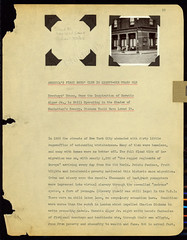
AMERICA’S FIRST BOYS’ CLUB IS EIGHTY-SIX YEARS OLD

Newsboys’ House, Once the Inspiration of Horatio Alger Jr., is Still Operating in the Shadow of Manhattan’s Bowery. Dickens Would Have Loved It.

In 1853 the streets of New York City abounded with dirty little ragamuffins of astounding wretchedness. Many of them were homeless, and many with homes were no better off. The full flood tide of immigration was on, with nearly 1,000 of “the ragged regiments of Europe” arrived every day from the Old World. Potato famines, fruit blights and intolerable poverty motivated this historic mass migration. Crime and misery were the result. Thousands of immigrant youngsters were impressed into virtual slaver through the so-called “padrone” system, a form of peonage. (Slavery itself was still legal in the U.S.). There were no child labor laws, no compulsory education laws. Conditions were worse than the worst in London which impelled Charles Dickens to write crusading novels. Horatio Alger Jr. might write heroic fantasies of fictional newsboys and bootblacks who, through their own efforts, rose from poverty and obscurity to wealth and fame. But in actual fact, the streets were over-run with vagrant children who, forced to live on their own resources, resorted to begging, stealing and worse. Some made a meagre living peddling rags, matches and newspapers. Mostly they slept in gutters, cellars and on doorsteps.

nyhs_cas_b-991_f-05_01_w

Continue reading

Song Lyrics: “They All Love Maggie Grady”

Tags

, , , ,

We know that female newsies existed, thanks to the photography of Alice Austin & Lewis Hines and the newspaper reporters who mentioned the various newswomen who sold during the strike (including the perennial favorite, “Annie of the Sun” Keeler). But how about the general public of the day? Well, just like many other aspects of newsboys & street urchins in pop culture, then as now, newsgirls were romanticized.

The following waltz was written in 1896, and performed by the Newboys’ Quintet. (The Newsboys Quintet, an act formed in 1896 by vaudeville agent James Hyde, boasted Gus Edwards—who discovered the Marx Brothers; was a founding member of ASCAP; and wrote popular songs & Broadway musicals—as a member.) Doesn’t it read just like a piece of “Newsies” fan fiction?

They all love Maggie Grady / w... Digital ID: 1166094. New York Public Library

“They All Love Maggie Grady”
Lyrics by Ed Gardenier & Music by Willim Slafer
1896

Just down there by the ferry, ‘mongst news boys gay and merry,
You’ll often meet a maiden fair and bright.
Who helps support her mother and little baby brother
By selling daily papers morn and night.
So happy once were they, ’till dear dad passed away
Then at the ferry Maggie took her stand.
The boys her story know it, their sympathy they show it,
By giving little Mag a helping hand.

Chorus
For they all love Maggie Grady,
She’s a perfect little lady
They feel entranced to catch a glance from little Maggie’s eye.
Yes all the lads respect her, they honor and protect her
So tip your hats like ‘ristocrats when Maggie passes by.

When she’s stuck on her papers, the lads all stop their capers,
They know she must be home at nine o’clock.
Then soon you’ll hear them yelling her papers quickly selling
They soon get rid of Maggie’s over stock.
Just to see her home at night, two rivals often fight,
The little maid to stop the jealous brawl
Talks to them like a mother, their anger tries to smother,
Saying lads you ought to know I love you all.