
Motion Picture: New York Police Parade, 1899

Tags

, , , ,

From the Library of Congress’s description:

“The film shows members of “New York’s Finest” parading at a crowded Union Square. There are members of the Bicycle Squad [Frame: 0396], mounted horses [0612], and two regimental marching bands [2518, 3456]. At the time of filming, the New York City Police Department was still recovering from the corruption scandals of the early 1890’s that had severely tarnished the reputation of the department. A State Senate appointed group known as the Lexow Committee investigated the department and issued a scathing report that detailed serious criminal activity within the department. In 1895, public opinion was so low that the annual parade wasn’t held. That same year, Theodore Roosevelt was appointed president of the Police Board, and he is credited with initiating strict and effective reform measures that helped restore the public’s confidence in the police.

From a contemporary Edison Company catalog: NEW YORK POLICE PARADE. Unbuilding. An excellent view of “The Finest,” on their annual parade and inspection, June 1, 1899. The head of the column is just turning into 14th Street from Broadway, the Morton House forming part of the background. Crowds line both sides of the cable car tracks, falling back as the band heading the first division swings around Dead Man’s Curve and passes the camera. Chief Devery makes a fine showing, as also do his men, with their white gloves and helmets, shining buttons and spick and span appearance in general.”
Song Lyrics: “Extra! Extra!”

Tags

, ,

“Extra! Extra!”

As sung in Edward Harrigan’s Local Drama, “Old Lavender.”

Words by Edward Harriggan.
Music by Dave Braham.

O mister, I’m a newsboy, hustling night and day,
A selling of my papers, and that’s not easy play.
Down town in the morning before they’re up in York,
I’m waiting for my Heralds, and a dancing on the walk.

It’s “Extra! Extra!” ’round the town I go;
A murder and a suicide, and Barnum’s great big show.
It’s “Extra! Extra!” Congress in a fight–
Elopement o’er in Jersey, with a preacher getting tight.

On mister, there’s a cripple–little Jimmy Ryan,
I help him sell his papers because his mother’s blind.
Can’t he sing a ballad! it aint no use to talk!
A darling ‘mong the newsboys, when he’s singing on the walk.

It’s “Extra! Extra!” ’round the town I shout;
The Fenians captured Canada andd Gladstone’s got the gout.
It’s “Extra! Extra!” Sinking of a ship–
Embezzlement in Wall street, and a barber lost his lip.

We get our cakes and coffee red hot from the can,
With buckwheat cakes and lasses enough to feed a man.
All the Jersey farmers, and ev’ry country gawk,–
They stop to see the newsboys when they dance upon the walk.

It’s “Extra! Extra!” this is what I cry;
A Democratic vict’ry down in Penn-syl-va-ne-i.
It’s “Extra! Extra!” France and Germany,
They’re goin’ to fight with all their might to lick the poor Chinee.

I sit up in the gall’ry watching of the play;
Oh I know all the actors, and this is what they say,–
I am King of Denmark, you ought to hear me talk,
And pouting to the newsboys when we’re on the Herald walk.

It’s “Extra! Extra!” this is what I cry;
A blizzard out in Michigan–a marriage on the sly
It’s “Extra! Extra!” Cashier’s run away,
And collar’d all the boodle and he’s skipt to Canada.

“Newsboys Eat Their Fill”

Tags

, , , ,

From the April 14, 1902 edition of the New York Sun:

Newsboys Eat Their Fill.

Twelve Hundred of Them Dined by Randolph Guggenheimer.

Twelve hundred newsboys from this borough and Brooklyn had a dinner at the expense of the Hon. Randolph Guggenheimer in the Newsboys’ Lodging house last night. Mr. Guggenheimer’s Brooklyn guests to the number of 500 came over in five special trolley cars. There was a car from Greenpoint, one from East New York, one from Fifth avenue and two from Borough Hall in Brooklyn.

The cars all got together at the Borough Hall plaza and came over in line, their occupants relieving the monotony of the trip by catcalls and such suggestive songs as “All I Want is Dat Chicken.” According to those who gathered in the boys for the feast, some of them from the more remote sections of Brooklyn had not been over the Bridge before in their lives. Traffic at the loops was tied up for some minutes while the boys scrambled out of the cars and formed into twos to march to the lodging house.

When the visitors reached the lodging house they were taken upstairs to the library, where the Manhattan boys were waiting. A few dark glances were exchanged. The Brooklyn boys wore white silk badges supplied by a Brooklyn newspaper. The Manhattan boys didn’t have any badges. Some of them looked as though the Brooklyn boys wouldn’t have badges if they were outside.

The Brooklyn boys were kept in one end of the room and the Manhattan boys in another and between them was a detail of policemen so there was “nothin’ doin’.”

Mr. Guggenheimer made a speech before they were allowed to go into the feast. To avoid any chance of trouble, the Brooklyn boys ate first. The managers said it was because the special cars were waiting for them, but the Manhattan boys took the other explanation. The Manhattan boys had to remain in the library and listen to other speeches from Edward McKay Whiting and other friends of Mr. Guggenheimer until the Brooklyn boys were fed.

After the Brooklyn boys were through they were taken upstairs and thanked Mr. Guggenheimer, who made another little speech and invited them over the Bridge again next year, an invitation they received with a shout that made the roof rattle. Then they marched to the cars and went singing and yelling back to Brooklyn.

There was plenty to go around and the Manhattan boys had their fill as well. Manhattan and Brooklyn together ate up 700 pounds of turkey, four barrels of potatoes, four barrels of turnips, 300 loaves of bread and fifty quarts of ice cream.

“She Fled Without Her Hair”

Tags

, , , , , , ,

From the March 27, 1894 edition of the New York Tribune:


She Fled Without Her Hair

The Strange Disappearance of Girl Who Cut Off Her Tresses and Carefully Left Them on the Bed.

Jane Hanihan, twenty-one years old, who had been employed as a chambermaid at the Newsboys’ Lodging House, at Duane and New Chambers sts., for the last sixteen months, was reported missing yesterday at Police Headquarters by her mother, who lives at No. 12½ Washington-st.

The girl slept at the lodging-house with the cook. About 5:30 o’clock yesterday morning she arouse and, without giving any explanation, cut off her hair, which she left on the bed, wrapped in a paper. She then left the building, with a black sacque thrown over her head. No trace of her has since been obtained. She wore a black skirt and button shoes.

Jane’s mother was seen last night at No. 12½ Washington-st. She said her daughter was a girl of good habits, and, so far as she knew, Mrs. Hanihan feared that her daughter had met with foul play, as she had no reason to believe that she had made away with herself.

Mrs. Heig, the matron of the Newsboys’ Lodging House, said that she knew of no reason why Jennie should go away. It was learned from several of the employes [sic] of the Lodging House that on Sunday morning there had been some trouble about the quantity of milk put in the coffee when it was made. Jennie, by accident, put in much more than was necessary, and was called to account for this. Jennie was a sensitive girl, and she and another girl, named Ellen Prochen, sent out and bought milk enough to make up for the loss, paying for it with their own money. For several days past Jennie had been feeling down-hearted. On Sunday evening about 6 o’clock, she met one of the men employed about the building, and asked him if any of the drugstores were open. She said that she wanted to buy some paris green, but she did not go out at that time.

Some friends of the family declare their belief that the girl committed suicide.

Philip Marcus on Information

Tags

, ,

V

The newsboy was always a good source of information in those days. Like the cops are today. Since the automobile come in, you’d be surprised to know how many kinds o’ questions are asked of the cops. But the newsboy was the original. You could find out from us almost anything you wanted to know, where the saloons were—only you didn’t have to ask much about them—, the location of the gambling joints, the whorehouses, almost anything, from the location of the First National Bank to the best place to got a piece of tail cheap.

Song Lyrics: “The Pride of Newspaper Row, Jimmy”

Tags

, ,

Jimmy Jones is me name,
Selling papes is me game
I’m de toughest kid ever on earth,
If you ask where’s me home,
From a box to de dome
of de World Building does for me berth.

All de kids tip dere hats
Or I’d break in dere slats
Dey all knows me wherever I go.
You can her dem all say
As I go by each day
Dat’s de Pride of Newspaper Row.

Refrain
Jimmy, Jimmy,
Dats de salute de gimme,
E’vrybody bows to me where ever I go,
Jimmy, Jimmy,
You are de real thing, Jimmy,
You are the quickest, de cutest and slickest
De Pride of Newspaper Row.

When de extrys is out,
You can bet I’m about
At de same old stand den I’ll be found
And de cops on de beat
When we chance for to meet
Never tells me to keep of de ground.

And it’s dis kind of hunch
Makes a hit wid de bunch
And I keep it up just for to show
Dem geezers dat dey
Have good reason to say
He’s de Pride of Newspaper Row.

Refrain

“Sammy Walked Sidewise.”

Tags

, , , , ,

From the March 11, 1902 edition of The Sun:

Sammy Walked Sidewise.

Joke for the Youngsters in the Newsboys’ Home, but Not for Sammy.

Sixteen-year-old Sammy Broom, who lives at the newsboys’ lodging house in East Forty-fourth street, was taken to Bellevue Hospital last night suffering from a stiffened knee, the result of inflammation of the glands between the joints, caused by a fall. The boy’s right leg was drawn backward, so that he was compelled to hobble along sidewise, like a crab. The two newsboys who took him to the hospital dragged him into the office.

“Hello, Doc,” said one of them, “we brought around Broome, de human crab. He walked backward all de way to de hospital. Hey, Broome, give de doctor a exhibition.”

“‘Taint on no funny bone,” said Broome, “it’s on my kneecap, and dat’s no joke. De bunch up in de newsboys’ says if I don’t git it hammered straight I could die in er night.”

“All right,” said the doctor, “we’ll take care of you.”

He had to chase the other boys away. They wanted to see the “human crab” walk again, they said.

“Redeeming Street Waifs”

Tags

, , , , , , , ,

From the March 3, 1895 edition of the Omaha Daily Bee:

Redeeming Street Waifs

Work Accomplished by the Children’s Aid Society of New York.

The Story of Patsy and Mickey

Street Arabs Taken from the City and Placed in Good Homes and Encouraged to Become Good Citizens.

Every six weeks a party of twenty boys is drafted from the ranks of the Newsboys’ lodging houses in New York City, are put in charge of an agent of the Children’s Aid society, and distributed through all parts of the west and south, from the prairie farms of Dakota to the orange groves of Florida.

The man who conducts a company of these sharp-witted, mercurial individuals over 1,000 miles of territory, necessarily leads a life untinged with monotony. Some of the experiences of Mr. B. W. Tice, one of these agents, for many years identified with the emigration department of the society, are better told in his own words.

“Several years ago,” said he, in conversation with the writer, “I started out for the far west with as lively a crowd of boys as it would be possible to find. Most of them were Irish and Canadian, the ones who are always getting into trouble, and who also make best use of their opportunities. Anyone of them would fight at the drop of a hat, and I assure you that it was a difficult undertaking to keep them from annihilating each other on the journey.

Patsy the Biffer.

“The star member of our troupe was an Irish boy, about 16 years old, known as Patsy Biffer, or simply ‘Biffer.’ In addition to this, he had several other names, finding them necessary to use in protecting them against the police, his practice being to give different pseudonyms upon his different contacts with these functionaries, with whom he had extensive acquaintance. Through much practice h had become a very clever boxer, was an Alexandre in his way, and only waited for more worlds to conquer.

“One cold day we arrived at a small town in southern Nebraska, where there was in session, as I remember, a teachers’ county institute. The town had assumed a gala appearance, and the boys, as was the custom, left the hotel in the afternoon, to meander about and see the sights.

“A long time that night we waited supper on the ‘Biffer’ and several of his friends, and fiinally, and about half through the meal, they entered. Patsy presented a sorry sight. His one eye was nearly closed, his hat was rimless and his clothes and tatters. Though unable to conceal his old defiant Bowery swagger, he, nevertheless, looked somewhat askance at me, so I turned to Mickey Morrell, his right-hand man, for the story. Mickey, who was glowing with suppressed excitement, related the events more graphically than lucid.

Continue reading

“Newsboys Warn Senator to Stick to His Own Stoop”

Tags

, , ,

From the February 23, 1903 edition of the Washington Times:

Newsboys Warn Senator to Stick to His Own Stoop

Object to Law Limiting Age of Venders of Dailies.

NEW YORK, Feb. 23—At the Washington Birthday dinner given to the newsboys by Randolph M. Guggenheimer yesterday at the Newsboys’ Lodging House State Senator Henry W. hill, of Buffalo, was roundly censured by many a street youngster, and the bill he has introduced at Albany making it unlawful for children under twelve years of age to sell newspapers or shine shoes was doneunced [sic] by many tongues.

“Senator Hill lives in Buffalo, don’t he?” said Johnny Murray, known to his intimate friends as “The Chink.” “There’s two or three things about New York that he ain’t thoroughly intimate with. The best thing for him to do is stick to his own stoop; we don’t want no bills passed so kids can’t work—not in New York. I’ll see that the governor knows it, too.”

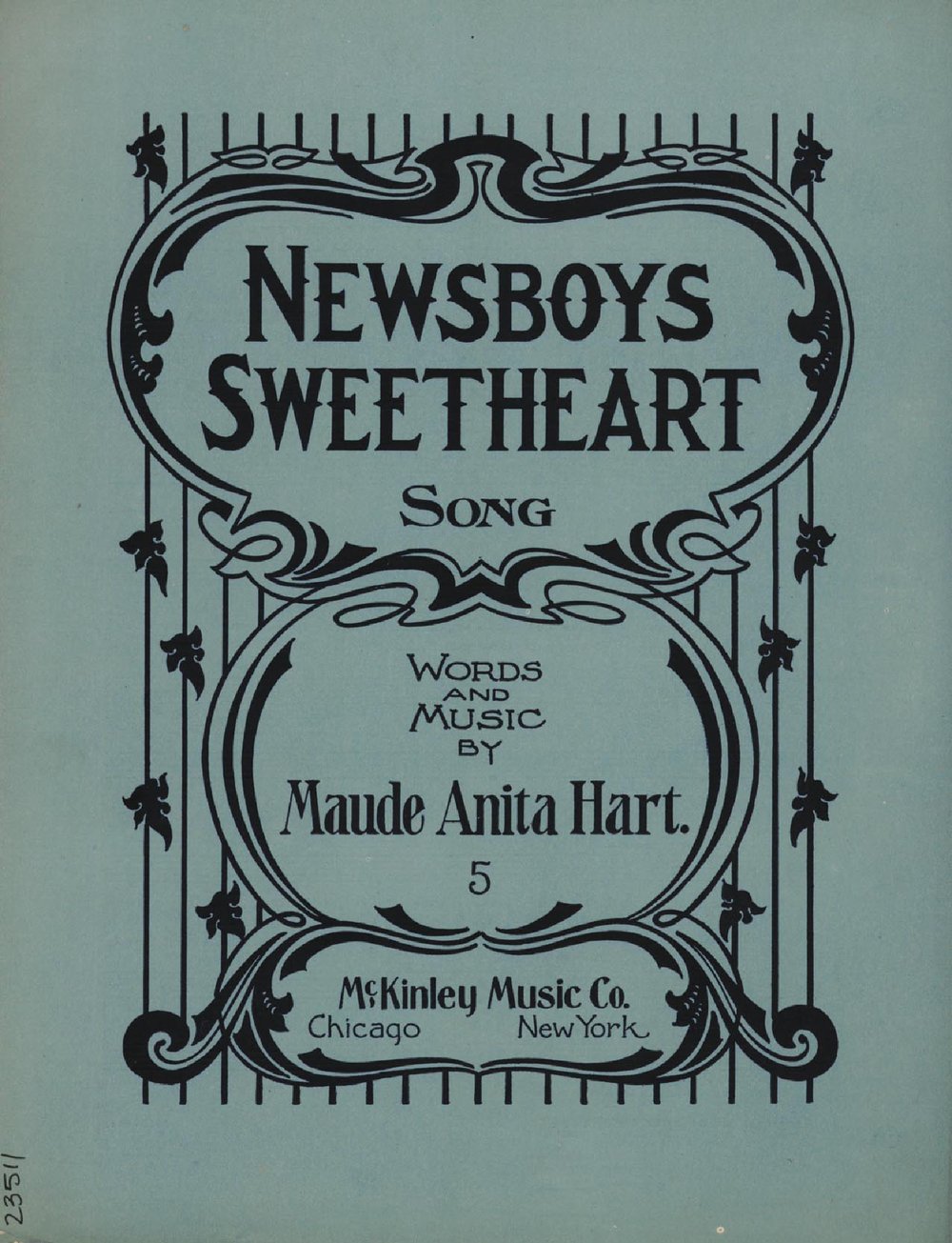
Song Lyrics: “The Newsboys Sweetheart”

Tags

, , ,

newsboyssweetheartcover

“The Newsboys Sweetheart”
Words & Music by Maude Anita Hart, 1905

My sweethearts name is Dolly
I haven’t known her long
But all the time I’m singing
And Dolly is my song
I’m nothing but a newsboy
Sell papers ev’ry day
To those who ride in coaches
To read while on their way
Twas there I met my Dolly
Became her loving swain
And now I’m always wishing
For Dolly on the train.

Chorus
My Dolly is the dearest,
The sweetest girl I know
She’s just my precious darling,
And O I love her so
Yes love my dark-eyed beauty,
In sunshine or in rain
My heart is O so happy
When Dolly’s on the train.

Her Papa guides the lever
As speeds the train away
And often takes my Dolly
With him to spend the day
But sometimes he will send her
Down in the coach to ride
And then will haste the newsboy
So quickly to her side
Yes I am but a newsboy
Have tried her love to gain
The love of little Dolly
My Dolly on the train.

The sequel now will show you
‘Tis right to persevere
For Dolly says she loves me
And that I am so dear
She’s given me her promise
My wife some day to be
‘Twill be such joy and gladness
Her face to always see
And now I am so happy
In sunshine or in rain
For meeting little Dolly
My Dolly on the train.