• Home
  • Newspaper Articles
    • The Brooklyn Eagle
      • July 20, 1899: “Newsboys Start A Strike.”
      • July 21, 1899: “The Newsboys’ Strike.”
      • July 24, 1899: “Messenger Boys Join the Army of Strikers.”
      • July 24, 1899: “The Newsboys’ Strike.”
      • July 30, 1899: “The Newsboys’ Strike.”
    • The Evening Post
      • July 20, 1899: “Newsboys on Strike.”
      • July 20, 1899: “Strike Days in Wall Street.”
      • July 21, 1899: “Newsboys Still on Strike.”
      • July 22, 1899: “Newsboys Aggressive.”
      • July 24, 1899: “Newsboys Want to Parade.”
      • July 25, 1899: “Newsboy Strikers Orderly.”
      • July 26, 1899: “Newsboy Leaders Quit.”
      • July 26, 1899: “Condition of the Newsboys.”
      • July 27, 1899: “Newsboys’ Strike Still Firm.”
      • July 29, 1899: “Newsboy Strike Leaders”
      • July 31, 1899: “Newsboys Form A Union”
    • The Evening Telegram
      • July 20, 1899: “Newsboys Strike Against Two Papers”
      • July 21, 1899: “Newsboys’ Strike Spreads to Harlem”
      • July 22, 1899: “Boy Strikers Sweep the City”
      • July 24, 1899: “Can’t Break Boys’ Tie-Up”
      • July 25, 1899: “Newsboy Strike Gains Ground”
      • July 26, 1899: “Newsboys Ready to Show Strength”
      • July 27, 1899: “Salvation Lassies Wouldn’t Sell Them”
      • July 28, 1899: “Newsboys See Victory Ahead”
      • July 31, 1899: “Union to Enforce Newsboys’ Strike”
    • The Morning Telegraph
      • July 21, 1899: “Newsboys Turn Out on Strike”
      • July 22, 1899: “Newsboys Strike A Great Success”
      • July 23, 1899: “Newsboys Still Out On Strike”
      • July 25, 1899: “Tim Sullivan Makes A Talk”
      • July 28, 1899: “Newsboys’ Strike Must End”
      • July 29, 1899: “Kid th’ Blink” No longer on Top”
    • The New York Herald
      • July 21, 1899: “Newsboys Strike for Better Terms”
      • July 22, 1899: “Spread of Strike Fever Among Lads”
      • July 23, 1899: “Newsboys’ Strike Promises Success”
      • July 25, 1899: “Newsboys Wage A Merry War”
      • July 26, 1899: “Newsboys’ Strike Becomes General”
      • July 27, 1899: “Newsdealers and the Boy Strikers”
      • July 28, 1899: “Dealers Boycott to Aid Newsboys”
      • July 29, 1899: “Newsboy Strikers Keep Up the Fight”
      • July 30, 1899: “Striking Newsboys Stand Firm”
      • July 31, 1899: “Newsboys Form An Organization.”
    • The New York Times
      • July 21, 1899: “Newsboys Go On Strike”
      • July 22, 1899: “The Strike of the Newsboys”
      • July 23, 1899: “Striking Newsboys Are Firm”
      • July 23, 1899: “Newsboys May Be Uniformed”
      • July 24, 1899: “Mass Meeting of Newsboys”
      • July 25, 1899: “Newsboys Act and Talk”
      • July 25, 1899: “Violent Scenes During Day”
      • July 26, 1899: “Newsboys Still Hold Out”
      • July 26, 1899: “Seek To Help the Newsboys”
      • July 27,1899: “Newsboys Are Weakening”
      • July 28, 1899: “Newsboys Still Hold Out”
      • July 31, 1899: “Newsboys Form A New Union”
      • August 1, 1899: “Newboys Up For Blackmail”
      • August 1, 1899: “Declare Newsboys’ Strike a Failure.”
    • The New York Tribune
      • July 21, 1899: “Newsboys Go On Strike”
      • July 22, 1899: “Newsboys’ Strike Goes On”
      • July 23, 1899: “Newsboys’ Word Stands”
      • July 24, 1899: “A Newsboys’ Meeting”
      • July 25, 1899: “Boys Forsee A Victory”
      • July 25, 1899: “Newsboys Riot in Mount Vernon”
      • July 25, 1899: “Trenton Newsboys Strike”
      • July 25, 1899: “Park Row Capulets and Monatgues”
      • July 26, 1899: “‘Newsies’ Standing Fast”
      • July 26, 1899: “Yonkers Boys Form A Union”
      • July 26, 1899: “New-Haven Newsboys Strike, Too”
      • July 26, 1899: “Newsboys Striking In Paterson”
      • July 26, 1899: “Strikers in Cincinnati”
      • July 26, 1899: “Strikers Ahead in Mount Vernon”
      • July 27, 1899: “Tried for High Treason”
      • July 27, 1899: “Boys Eloquent in Brooklyn”
      • July 28,1899: “‘Kid’ Blink Arrested”
      • July 28, 1899: “Yonkers Boys Win A Victory”
      • July 28, 1899: “Providence Boys Join the Strike”
      • July 29, 1899: “‘Kid’ Blink Fined”
      • July 30, 1899: “Fable Repeated In Fact”
      • July 30, 1899: “New-York Newsboys,” Illustrated Supplement
      • July 31, 1899: “Newsboys’ Strike On Again”
      • July 31, 1899: “Yonkers Boys to Parade”
      • August 1, 1899: “Newsboys Plan Another Meeting”
      • August 1, 1899: “A Big Parade in Yonkers”
      • August 1, 1899: “Newsboys’ Strike in Asbury Park”
      • August 2, 1899: “Newsboys’ Boycott Over”
    • The Sun
      • July 20, 1899: “Newsboys ‘Go Out'”
      • July 21, 1899: “The Only Tie-Up In Town”
      • July 22, 1899: “Strike That Is A Strike”
      • July 23, 1899: “Newsboys’ Strike Swells”
      • July 24, 1899: “Plan to Down Newsboys”
      • July 24, 1899: “Sociological Students in Court”
      • July 25, 1899: “Great Meet of Newsboys”
      • July 25, 1899: “Troy Newsboys In Fight”
      • July 26, 1899: “Newsboys Parade To-Night”
      • July 27, 1899: “Parade To-Night, Sure”
      • July 27, 1899: “Newsboys Gain A Point”
      • July 28, 1899: “Newsboys Get New Leaders”
      • July 28, 1899: “Stole Newspapers from Girls and Women”
      • July 29, 1899: “Newsboys’ New Leader”
      • July 29, 1899: “A Kindergarten for Strikers”
      • July 31, 1899: “Rochester Newsboys to Go On Strike”
      • July 31: “Striking Newsboys Elect Officers”
      • August 1, 1899: “‘World’ Jails Newsboys”
      • August 2, 1899: “Newsboys Strike Up the State”
      • August 2, 1899: “Three Newsboys Arrested for Assault”
    • The World
      • July 30, 1899: “Herald Employees Sued for $10,000”
      • August 1, 1899: “Blackmailers Try to Profit by Strike”
      • August 3, 1899: “Plain Statement of Facts for Public Consideration”
  • Newsworthy Blog
  • Resources
    • Bibliography: Newspaper Articles
    • Links
  • About
  • Sitemap

City Hall Park 1899

~ History of the Newsboys Strike of 1899, through actual newspaper articles from the time.

City Hall Park 1899

Tag Archives: newsboys’ house

“Newsboys’ ‘Foster Father’ Tells How They Won Fame”

27 Saturday Jun 2015

Posted by cityhallpark1899 in Newspaper Articles

≈ Leave a comment

Tags

Brace Memorial Lodging House, Children's Aid Society, Henry L. Gassert, Johnny Brady, Johnny Burke, Josephine Beck, life, Little Minnie, Little Timmy, Mother Heig, Narrow Mike, newsboy code, newsboys, newsboys' house, newsies, oral history, Pop Rudolph, Rudolph Heig, Skinny, superintendent, Swipes, Yaller the Butcher

June 30, 1910 marked the last day that Rudolph Heig served as superintendent of the Newsboys’ Lodging House located at No. 9 Duane Street. His wife, who served as the lodging house’s matron, retired alongside him. The Evening Telegram ran the following article about his career on June 27, 1910:

Newsboys’ “Foster Father” Tells How They Won Fame

Pop Heig, Thirty-Five Years in Charge of Home, Relates Story of 100,000 Charges.

“Pop” Rudolph is going to quit. That is not all. “Mother” Heig has decided that she will have to leave with him, and as she is his wife it isn’t strange that she reached this conclusion. Of course the announcement doesn’t mean much to the ordinary New Yorker when there are other things to read about and he is not sure yet whether the Jeffries-Johnson fight is really going to take place or the Giants are beginning to get in better form. It is merely a little item sandwiched in among a lot of advertisements announcing that the Children’s Aid Society has accepted the resignations of Mr. and Mrs. Rudolph Heig as superintendent and matron, respectively, of the Newsboys’ Home, at No. 14 New Chambers street, and that some one else will be appointed to take their places. It doesn’t mean much to some, but it certainly does mean a whole lot to more than a hundred thousand boys and one girl who knew them as their friends, aids and advisers when every one else in the whole world was against them and the outlook for life was about as black as it can appear to the juvenile mind, which ought to be naturally optimistic. It doesn’t mean newsboys who regret their leaving, but it means newsboys, Governors of States and Territories, financiers and lawyers, who still regard the couple as the only persons in the country who took them in and befriended them when no one else thought them worth caring for.evetelegram_6-27-1910_mrs-mrs-heig

Started as Newsboy.

“Pop” Rudolph Heig didn’t make any fortune for himself and neither did his wife, known from coast to coast by thousands of boys as “Mother Heig.” but if the youngsters whom they have befriended and put on the right road since they first took charge of the Newsboy’s Home had their way they would have the first place in the hall of fame.

Having started life as a newsboy himself there was no one whom the Children’s Aid Society could pick who was more eminently fitted for the place of superintendent of the home for the “newsies” when the home was opened in New Chambers street thirty-five years ago than Mr. Heig. At that time he was a youngster himself, having given up his selling papers in Park row to become office boy in the uptown office of the society and then clerk. He knew boys, and especially newsboys, as only a man who was one himself could know them. He was as well acquainted with their code of honor, division of districts and unwritten fraternal laws as they were themselves and he knew that a newsboy wasn’t to be treated with the same regulations that a youngster of the upper ten would expect. To be pampered and coaxed was disgusting to them, and to have any one start in “preaching” in a vernacular they didn’t know was something that any youngster who had to hustle for himself hated worst of all. Mr. Heig knew this.

A reception is to be tendered Mr. and Mrs. Heig on Thursday night, which will be the last night they will spend in the old lodging house, and it is expected that their boys from all parts of the country will be present.

Continue reading →

“Waldorf Room at the Newsboys’ Lodging House”

17 Friday Apr 2015

Posted by cityhallpark1899 in Tribune

≈ Leave a comment

Tags

Brace Memorial Lodging House, Collars, Dutch Pete, Five Cent Blokes, life, newsboy code, newsboys, newsboys' house, newsgirls, Paddy the Pug, photographs, Reggie from Paris, savings bank, superintendent Heig, The Man Behind, Waldorf Gang, Waldorf Room

From the New York Tribune’s Illustrated Supplement on April 17, 1904:

Waldorf Room at the Newsboys’ Lodging House

Some Picturesque Characteristics of the Little Fellows Who Sell “Uxtrys” in the Streets of New-York.

Whatever the newsboy may lack in appearance, he has a bottom all the instincts of an aristocrat. Let the sunshine of prosperity beam on him even for a moment, and he buds with the true flowers of a patrician. If he makes a couple of dollars by the help of the Japanese fleet, whose latest manoeuvres has furnished him with a startling bit of news, he spends his money with a lavish hand. instead of a box at the opera, he buys tickets for the “gang” just beneath the grimy roof of some Bowery theatre.

A striking illustration of the “newsies” latent gentility is furnished by a new feature of the Newsboys’ Lodging House, near Chatham Square, which has been called the “Waldorf room.” Although plenty of white, clean beds were to be had in the two big halls for 5 and 10 cents a night, yet an exclusive circle of newsboy society demanded apartments of great privacy. Some of them had obtained work in nearby business houses, where they were enjoying incomes of $10 and $15 a week; and as “Dutch Pete,” who is now loading delivery wagons across the alley from the lodging house expressed it:

“W’en you’se got de wad, you’se might as well lif’ like a gent. An’ yer can’t be a gent widdout piracy. yer can’t mix up wid de bunch and perserve yer rights as a gent.”

Continue reading →

New York Times, December 22, 1860

22 Sunday Dec 2013

Posted by cityhallpark1899 in NY Times

≈ 1 Comment

Tags

Children's Aid Society, newsboys' house

The following article was originally published in the December 22 issue of the New York Times, in 1860.

THE CHILDREN’S AID SOCIETY.; The Newsboys’ Lodging Room—Its Occupants—A Speech from Paddy—A Few Stern Facts.

There is something about childish poverty that touches the heart of every true man. We have no right to assume that a poor child is necessarily lazy or vicious, and the youthful sufferer seems to represent to us, for the time, social evils of whose distant influence it is the innocent victim. In this City there are thousands of children who are homeless, destitute of clothing and of money, beyond the reach of the older means of Christian influence, and fast drifting way towards that dismal swamp from whence come the robbers, the prostitutes, the murderers of society.

The boys are made keen, bright, and smart by neessity [sic]. The girls, unless necessitous, are tempted as the boys are, though they have not before them, as the thers have, even the possibility of a noble future if once they have plunged into a career of vice.

We have frequently spoken with warm commendation of the Children’s Aid Society, which has been organized for the relief and redemption of this class of our City poor. One of its features is the Newboys’ [sic] Lodging-house, in Fulton-street, — where cheap lodgings are provided, and evening meetings are held for the improvement of the boys. A sketch of an evening lately spent there may be of interest, and serve to illustrate the general influence of the Association in this department of its labors.

The room contained some sixty boys, seated on benches and stools. Around it were lockers, in which each boy could place his surplus clothing, if he had any. On the walls were hung encouraging mottoes, such as “Cheer, boys, cheer;” “All work and no play makes Jack a dull boy;” “Be content with such things as ye have;” and various Scriptural placarded sentences, encouraging to the virtuous and disheartening to the wicked; also engravings, and several colored pictures.

On an elevated platform were a matron, a melodeon and a bank. The first-named has charge of the devotional exercises of the boys, mends their clothes, and plays upon the second; while the third, as its name implies, is used as a receptacle for the surplus cash which the boys may be willing to save. It consists of an ordinary deal table, the top of which has a great number of slitted-holes, through which, into boxes within, the depositors can drop the change. This plan is found to work admirably. No boy can take the money so deposited unless a majority of the lodgers vote in favor of “specie payment.” One young lad has saved $150, another $100, and others in smaller sums, such as $50, $25, $10, and so on — sums which, though insignificant, possibly, to Mr. ASTOR, are of incalculable assistance to a boy who has no boots, coat or cap.

A peep into the sleeping-rooms satisfied us that the place was well denominated “lodging-rooms.” There are an upper and a lower room. The former is considered, in comparison, with the latter, as a cheap restaurant is with the Metropolitan Hotel. In it seventy boys can be comfortably lodged; the beds are like berths, one above another, and provided in each case with comfortable and sufficient bedding. In it are lodged irregular boys, and those who, coming for the first time, may not be perfectly free from all the [???]lls that dirty flesh is heir to; while the lower apartment is reserved for the cleanly, regular and never-away boarders, who prefer the iron bedstead, the more lofty ceiling and perfect security from vermin.

Adjoining these rooms are adequate bathing accommodations, in which, with hitherto unaccustomed joy, the boys delight to swash.

As we reentered the room where the boys were seated, Mr. BRACE announced that he and one or two others would make a few remarks, they could all have a sing, and then gratify their palates by some goodies which a kind friend had thoughtfully prepared for them. In his usual happy manner Mr. BRACE spoke to them, familiarly teaching and pleasantly advising them, so that one and all were evidently pleased to hear him, and in no way considered him a bore. In fact, it requires a peculiar person to manage and talk to these boys. Bullet-headed, shorthaired, bright-eyed, shirt-sleeved, go-a-heud boys. Boys who sell papers, black boots, run on errands, hold horses, pitch pennies, sleep in barrels and steal their bread. Boys who know at the age of twelve more than the children of ordinary men would have learned at twenty, who can cheat you out of your eye teeth, and are as smart as a steel-trap. They will stand no fooling; they are accustomed to gammon, they live by it, — and yet we could not fail to notice that the steady, earnest, faithful year-by-year work of Mr. BRACE in their behalf had so rooted him in their esteem, that let him say or do what he chose, he could not wrest from them the conviction that he loves them, and would cheerfully do anything in the world to aid them and ameliorate their condition. We pity the man, or body of men, who should in any way do bodily ill to Mr. BRACE; he would find soon upon his heels a set of young avengers, from whose clutches he could not escape, and who would visit upon him chastisements most summary and severe. No audience that ever we saw could compare in attitudinizing with that one. Heads generally up; eyes full on the speaker; mouths, almost without an exception, closed tightly; hands in pockets; legs on the desks, or over a neighboring pair; no sleepers, all wide-awake, keenly alive for a pun, a point, or a slangism. Winding up, Mr. BRACE said: “Well, boys, I want my friends here to see that you have the material for talkers amongst yourselves; who do you choose for your orator?”

“Paddy, Paddy,” shouted one and all. “Come out, Paddy. Why don’t you show yourself?” and so on.

Presently Paddy came forward, and stood upon a stool. He is a youngster, not more than twelve, with a little round eye, a short nose, a little form, and chuck full of fun.

“Bummers,” said he “snoozers and citizens, I’ve come down here among ye to talk to yer a little. Me and my friend BRACE have come to see how ye’r gittin’ along, and to advise yer. You fellers what stands at the shops with yer noses over the railin,’ smellin’ ov the roast beef and the hash — you fellers who’s got no home — think of it how we are to incourage ye. [Derisive laughter, “Ha-ha’s,” and various ironical kinds of applause.] I say, bummers — for you’re all bummers — so am I [great laughter] — I hate to see you spendin’ your money on penny ice creams. Why don’t you save your money? You feller without no boots, how would you like a new pair, eh? [Laughter from all the boys but the one addressed.] Well, I hope you may get ’em, but I rayther think you won’t I have hopes for you all. I want you to grow up to be rich men — citizens, Government men. lawyers, ginerals and influence men. Well boys, I’ll tell you a story. My dad was a hard ‘un. One beautiful day he went on a spree, and he come home and he told me, where’s yer mother, and I axed him I didn’t know, and he clipt me over the head with an iron pot, and knocked me down, and me mither drapped in on him, and at it they went. [Hi-hi’s, and demonstrative applause.] Ah! at it they went, and at it they kept — ye should have seen ’em — and wilst they were fightin’. I slipped meself out the back door, and away I went like a scart dog. [Oh, dry up! Bag your head! Simmer down!] Well, boys, I wint on till I kim to the Home for the Friendless,’ [great laughter among the boys, who are rather down on that institution,] and they took me in, (renewed laughter,] and did for me, without a cap to me head or shoes to me feet and thin I ran away, and here I am. Now, boys, (with mock solemnity.) be good, mind yer manners, copy me, and see what you’ll become.”

At this point the boys raised such a storm of hifalutin applause, and indulged in such characteristic demonstrations of delight, that it was deemed best to stop the youthful Demosthenes, who jumped from his stool with a bound that would have done credit to a monkey, and was soon involved in a scrimmage with a big boy who believed all Paddy had said, with the exception of the “iron pot.”

At this juncture huge pans of apples were brought in, and the boys were soon engaged in munching the delightful fruit, after which the matron gave out a hymn, and all joined in singing it, during which we took our leave.

This is but a specimen of the way in which these boys spend their evenings. At other times they are read to, talked to, legitimate games are played, stories are told, letters from old companions who have gone out West are read, and occasionally a returned agent recounts his experience in the far-off country, and excites their desire to participate in the comforts of a new home.

The boys, who are literally self-supporting, regard this lodging-house as their home, and the managers stand in the relations of father and mother. No one is compelled to go there, and no one is denied a bed. If flush he pays a cent for it — if out of funds he is trusted. Oftentimes the regular lodgers find poorer boys in the street, take them to the lodging-house, pay for their bed, beg for them an outfit, and give them a lift which may be the making of their fortunes and the establishment of a successful boot-black box, or a trading armfull of papers.

We have neither space or time to follow the ramifications of the workings of this Society in other directions. The German and Italian schools are well arranged, carefully tended, and most beneficial in their results. In these times hundreds of children are thrown upon the cold charity of the City, who at other seasons can live with their parents. This Society can do a great deal, and is doing wonderfully, but its energies are not half developed, simply from the lack of means. Does not this channel of Home Missionary work commend itself to the benevolent citizens of New-York? Is it not worth an effort to save these boys and girls from lives of sin and shame? Already several thousands have been taken to the West, settled in good homes and put on the track of future usefulness and possible greatness. Thousands more want to go — to go away from the temptations, the poverty, the privations and the wickedness of this modern Sodom, and to begin anew in a land where crowds are less frequent and chances more numerous. Money, books, clothes, provisions, coal, bedding of all kinds — anything and everything that man can use or woman need will be cheerfully received, thankfully acknowledged, and fittingly applied. Now is the time to do good, if ever; ten dollars or ten bed-quilts given at this time will be of more actual service than ten times that amount given next Summer, and we earnestly recommend this enterprise to the investigation, the liberality, the patronage and the sympathy of the public, feeling sure that a better channel for conveying bounty to the deserving poor cannot be found here or elsewhere. “Whoso giveth to the poor, lendeth to the Lord.” Verbum sapienlibus. Nuff ced.
Night School of the Newsboys’ Lodging House

16 Saturday Nov 2013

Posted by cityhallpark1899 in Newspaper Articles, The Sun

≈ Leave a comment

Tags

general history, newsboys' house, night school

Originally published in The Sun on October 13, 1859:

The night school of the Newsboys’ Lodging House will open on Tuesday evening next. All poor boys desirous of improving themselves have an opportunity to attend. Books, papers, slates, &c., are provided without charge. The following statistics afford pleasurable proof of the good it is doing for this class.

Number of destitute boys sheltered by this charity for the quarter ending on the 15th of September, 4,198. Of these, 2,281 had meals. Of truant and lost boys from various parts of the Union, and even from the Canadas, 47 have been restored. A considerable number of boys from this Institution have been sent to homes in the West by the Children’s Aid Society. During the period above mentioned there have been only four cases of illness. Sick boys are not sent to the Hospital, except where the complaint is contagious. They have good medical advice, and are provided with medicines gratuitously.

A spirit of thrift and prospective economy is developing among the newsboys, owing to the establishment of the Bank of the Newsboys Lodging House. In this, within the above period, 52 boys deposited $216.62 of their earnings.

The Bank is opened on the 1st of every month, and the depositors receive from the institution 5 per cent. interest (per month) on their savings. Since the introduction of the Sunday dinners at the Lodging House on the 12th of June last, 869 have been saved from the necessity of working on the Sabbath at the comparatively trifling cost of about $49.00.

The mention of the inclement season will remind the humane reader at the same time, that donations of apparel and bed cloths will be very acceptable at the Lodging House, Sun Building, to which address they may be sent. Presents of stationery and of books for their library and night school will also be gratefully received.

“The Queer Little Savings Bank of the Newsboys’ Lodging House”

06 Sunday Oct 2013

Posted by cityhallpark1899 in Newspaper Articles

≈ Leave a comment

Tags

newsboys' house, savings bank, superintendent Heig

From the August 23, 1899 edition of the Oswego Palladium:

Our New York Letter

The Queer Little Savings Bank of the Newsboys’ Lodging House.

It Is Said to Be the Smallest in the World—Something About It’s Depositors and Superintendent Heig, the Pooh-Bah Who Runs It.

NEW YORK, Aug. 22—[Special.]—The Newsboys’ Lodging House at 9 Duane street is one of the most interesting institutions for the stranger here to visit and at the same time one of the most disappointing at this time of year, for, despite the fact that it was founded nearly 40 years ago and has no doubt wrought no end of benefits to the boys making use of its advantages, its inmates just now number a scant fivescore of all the thousands of newsboys in the town.

Explanation of this apparent discrepancy will tend to make the real nature and aims of the institution clear.

What the Newsboys’ Home Is.

The Newsboys’ Lodging House is not an institution for the housing of all the newsboys in this city nor even for any considerable proportion of them. Its accommodations would be crowded by 200 boys, and that, according to some estimates, would be less than 1 in 50 of the whole number. The real purpose of the institution is to select the homeless and friendless among the boys who sell newspapers, to look after each for awhile and then, in cases it seems warranted by the facts, to lift them quite out of the newspaper selling life and start them afresh, amid new surroundings, where they will have a chance to work out their own salvation unhampered by the crime and squalor and generally depressing conditions into which they were born. That the managers of the house have been unusually successful in this work is well-known by all who have given attention to the matter and may be indicated here by the statement that two at least of its former inmates transplanted through its managers’ efforts have risen to fill gubernatorial chairs, while a very large number have become self supporting, self reliant, highly respected and solid citizens and business men.

One of the things first sought to be impressed upon the boy who becomes a steady lodging at 9 Duane street is the necessity of frugality, the ___ of living within whatever income you happen to possess. To this end a savings bank, sometimes called the smallest in the world, was established at the beginning. This savings bank is run on principles that may be termed antitbetle [sic] to those one which the ordinary pawnshop is conducted. The legal rate of interest on ordinary sums in this state is 6 per cent, but in virtue of the extra risks they are supposed to assume and the small sums they lend the pawnbrokers are allowed to charge much more within the law. Ordinary savings banks pay not more than 3 or 4 per cent per annum, but the little savings bank of the Newsboys’ Lodging House pays 6 per cent a month, or 72 per cent a year. Of course this rate is in reality mostly a gratuity, paid for the sole purpose of encouraging the saving habit, and the maximum deposit allowed is $25. Moreover, as soon as the maximum is reached the rate is decreased to something like a business one.

And, as a matter of fact, few boys are encouraged to reach the maximum, for the management considers it quite as necessary to teach the right use of money as the necessity of saving it. Thus the boy who has got $10 or $12 together and needs clothing is advised to spend part of his savings in shoes or a hat or some other article of apparel. The heaviest deposit in the Newsboys’ Lodging House savings bank at this moment is $14.61, and it stands to the credit of William Gregg, a 17-year-old American lad. The total deposits at this time amount to $101.

Superintendent For 23 Years.

The machinery of this smallest savings bank is simple in the extreme, Randolph Heig, who has been superintendent of the home for 23 years, being president, bookkeeper, paying teller, receiving teller, etc., all rolled into one, a veritable Pooh-Bah in a small way, as a matter of fact.

Mr. Heig, by the way, is devoted to his calling. He is of middle height, wears a full beard and is of pleasant address. He studies his newsboys with the same degree of enthusiasm that a professor of entomology studies his specimens. Within a week after a boy enters the lodging house Mr. Heig has him pretty well analyzed and within a month is pretty certain to have decided upon a special course suited to the boy’s individual needs and capacities. It goes without saying that Mr. Heig possesses the power of making friends with boys to an unusual degree and that his is likely to know the story of each one in the home long before he was been analyzed and his immediate future mapped out.

To him they are encouraged to tell all their boyish troubles, some of which are far more real than fall to the lot of most boys. When they seem restless and apparently in need of amusement, he furnishes it for them. When, as sometimes happens, one of the omnipresent Gerry society agents takes in a lodging house boy in whom he has faith, Mr. Heig appears personally at the society headquarters or before the police justice and gets him out. When a boy is ill he tells his symptoms to “the super,” who hastens to look after him. Occasionally, despite the general “antiscrap” influence of the home, one of its inmates gets into a fight and comes in at night pretty badly banged up. When that happens, it is “the super” who binds up the hurts.

The fact that this is vacation time is one of the most important factors in the low deposits now in the lodging house savings bank and the small population of the home. Most of the lodging house boys take their outings at the Kensico farm, a tract of land 125 in extant owned by the Newsboys’ Lodging House association and fitted up with building and many appliances for the comfort of the boys. Sixty of them are there now enjoying fresh air, living on country fare and generally recuperating themselves. Many of the boys who go to the Kensico farm on vacations got out from its doors as employees of neighboring farmers and never come back to New York, at least until the y have grown to man’s estate and are able to earn their way by other methods than selling newspapers on the streets.

Superintendent Heig has kept track of every one of his boys who has gone out into the world in this way, and many of these are in regular correspondence with him to the present day.

Dexter Marshall.

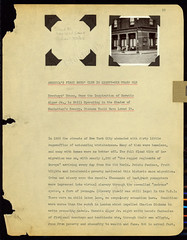
“America’s First Boys’ Club is Eighty-Six Years Old”: Part II

19 Tuesday Mar 2013

Posted by cityhallpark1899 in General

≈ Leave a comment

Tags

newsboys' house

The second half of a photo-essay, written around 1940, about the Children’s Aid Society’s Newsboys’ House. (Read the first half here.)

THERE ARE NO ALGER BOOKS IN THE LIBRARY…..

….but the the celebrated rags-to-riches romanticist spent plenty of time in Newsboys’ House, seeking atmosphere. A gentleman of eccentric turn, Alger used to haunt the streets of Manhattan after dark, disguised in flowing cape and false whiskers, rounding up vagrant youths whom he would escort to Newsboys’ House. Of a social turn of mind like Dickens, he helped stamp out the vicious “padrone” system (suppressed by the Italian government in 1873) through his book, “Phil the Fiddler.” Today’s Transient youths are less interested in the fabulous histories of Tom the Bootblack, Dan the Newsboy and others of that illustrious ilk than they are in keeping body & soul together. The library, gymnasium and other facilities of Newsboys’ House make for a pleasant and congenial club like while waiting for a “break.” Newsboys’ House has a capacity for 100 boys, and is usually at least 95% full. The average stay is 12 days. Some boys only stay a night, others remain until they are 21, when they must find accommodations elsewhere. On an average 1,600 boys are accommodated each year, but at the bottom of the Depression the figure rose to 4,000. Usually not more than one of the hundred or so boys is actually a newsboy. Most of their are either jobless or work as factory hands and errand boys. They come from every State in the Union and even from foreign countries, but most of them are from the farms and mill-towns of the South and West, where the going is hard. Many are sent back home by The Children’s Aid Society if circumstances warrant such action.

nyhs_cas_b-991_f-05_07_w

Continue reading →

“America’s First Boys’ Club is Eighty-Six Years Old”: Part I

19 Tuesday Mar 2013

Posted by cityhallpark1899 in General

≈ 1 Comment

Tags

newsboys' house

The New York Historical Society has, in their Flickr photostream, images & report scans from the archives of the Children’s Aid Society. The following is the first half of a photo essay written sometime around 1940, which gives a fascinating glimpse into how much life at a newsboys lodging house changed—and how much remained the same—in the forty years after the 1899 strike.

AMERICA’S FIRST BOYS’ CLUB IS EIGHTY-SIX YEARS OLD

Newsboys’ House, Once the Inspiration of Horatio Alger Jr., is Still Operating in the Shadow of Manhattan’s Bowery. Dickens Would Have Loved It.

In 1853 the streets of New York City abounded with dirty little ragamuffins of astounding wretchedness. Many of them were homeless, and many with homes were no better off. The full flood tide of immigration was on, with nearly 1,000 of “the ragged regiments of Europe” arrived every day from the Old World. Potato famines, fruit blights and intolerable poverty motivated this historic mass migration. Crime and misery were the result. Thousands of immigrant youngsters were impressed into virtual slaver through the so-called “padrone” system, a form of peonage. (Slavery itself was still legal in the U.S.). There were no child labor laws, no compulsory education laws. Conditions were worse than the worst in London which impelled Charles Dickens to write crusading novels. Horatio Alger Jr. might write heroic fantasies of fictional newsboys and bootblacks who, through their own efforts, rose from poverty and obscurity to wealth and fame. But in actual fact, the streets were over-run with vagrant children who, forced to live on their own resources, resorted to begging, stealing and worse. Some made a meagre living peddling rags, matches and newspapers. Mostly they slept in gutters, cellars and on doorsteps.

nyhs_cas_b-991_f-05_01_w

Continue reading →

Newer posts →

Create a free website or blog at WordPress.com.

Privacy & Cookies: This site uses cookies. By continuing to use this website, you agree to their use.
To find out more, including how to control cookies, see here: Cookie Policy
  • Subscribe Subscribed
    • City Hall Park 1899
    • Join 55 other subscribers
    • Already have a WordPress.com account? Log in now.
    • City Hall Park 1899
    • Subscribe Subscribed
    • Sign up
    • Log in
    • Report this content
    • View site in Reader
    • Manage subscriptions
    • Collapse this bar
 

Loading Comments...